
Water Damage Restoration in Lafayette, LA
Water damage restoration in Lafayette is a matter of hours and readings. The Louisiana Department of Health says that in most cases mold will not grow if wet areas are dried within 24 to 48 hours, and restoration is the work of meeting that window: water extraction, wet materials pulled or opened so air can reach them, and air movers and dehumidifiers running until moisture meters say the structure is dry. A burst supply line, a roof leak after a storm, an overflowing appliance or water from outside all start the same clock. Call (337) 294-0039.
Call (337) 294-0039 Request a callback
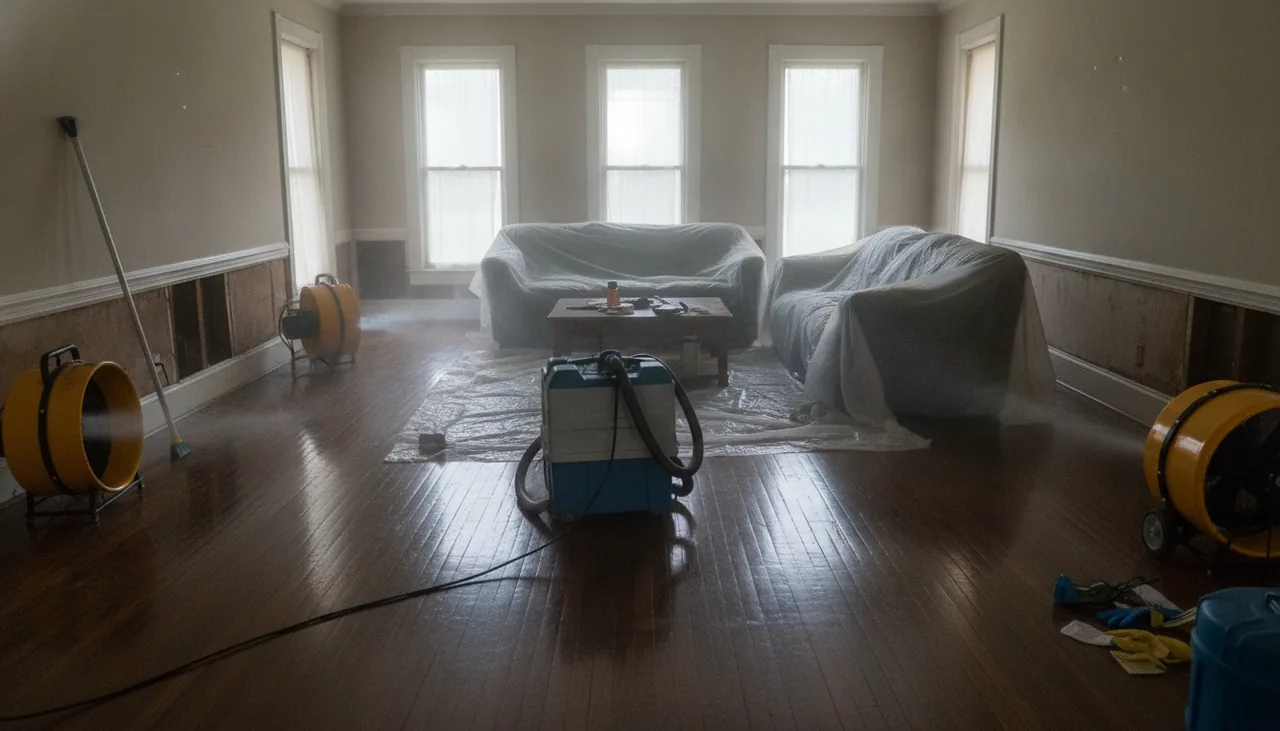
The first hours after water damage
- Stop the water at the main valve or the fixture valve. If water has reached outlets or cords, switch off that circuit at the breaker before going in.
- Photograph every wet room, the source and the water line on walls, before anything is moved.
- Lift rugs, furniture legs, boxes and papers off wet floors.
- Call your insurer to open a claim, and note the claim number.
- Call (337) 294-0039 for extraction and drying.
How water damage restoration is carried out
Mapping. Moisture meters and a thermal camera trace how far the water went, which is nearly always farther than the visible stain, especially under flooring and inside walls.
Water extraction. Standing water and water held in carpet and pad are pulled out with extraction equipment.
Opening up. Materials that cannot dry in place, such as soaked pad, wet batt insulation and swollen baseboard, come out; small holes at the base of walls let air into the cavities.
Drying. Air movers and dehumidifiers run, with readings recorded each visit, until wood and wallboard are back to normal levels.
Records. Photos, readings and a list of removed materials go into the file your adjuster works from.
If water stood long enough for growth to start, the next step is a mold assessment by an independent firm and removal by a separate remediation contractor, the split Louisiana law requires (La. R.S. 37:2158(A)(23)). See post-flood mold remediation.
Clean water, gray water and floodwater damage
Where the water came from decides what can be saved. Water from a supply line is clean at first, and most materials it reaches can be dried. Water from a washing machine, a dishwasher or a sink drain carries more, and pad and porous materials it soaks usually go. Sewage and outside floodwater are treated as contaminated: the Louisiana Department of Health says you will need professional help if the water or mold damage was caused by sewage or other contaminated water, and far more material has to come out.
Storms, rivers and water damage in Lafayette
The Atlantic hurricane season runs from June 1 to November 30 (National Hurricane Center), and since 2000 Lafayette Parish has been part of 16 federal disaster declarations for hurricanes, tropical storms and floods. Hurricane Gustav brought a 67-knot gust and 6.62 inches of rain to Lafayette Regional Airport in 2008, and Hurricane Laura dropped 7.91 inches there in 2020.
The river adds its own risk. The Vermilion is the parish's main stormwater outlet, and at high stages it can even run backward: when the channel below Pinhook Bridge cannot carry the flow, water reverses upstream toward the low marsh east of the parish. At 14 feet on the Surrey Street gauge, the National Weather Service expects significant flooding where coulees and bayous meet the river.
Water damage restoration cost in Lafayette
Extraction and drying caught early, within the first couple of days, usually comes to around $2,000. The figure rises with the amount of water, how long it stood, what it soaked and whether it was contaminated. Once mold has started, remediation is a separate line: $1,500 to $4,500 for a room, and $10,000 to $30,000 or more for a house that took floodwater and was closed up wet. The cost page has the full table.
Calling about water damage
Call (337) 294-0039 and say where the water came from, when it started, which rooms it reached and whether it has been stopped. The line takes calls at any hour, and the callback form below works too. Keep the rooms ventilated with the water shut off.
Water damage restoration questions
How soon can mold start after water damage?
The Louisiana Department of Health says that in most cases mold will not grow if wet areas are dried within 24 to 48 hours, so drying should start inside that window. Call (337) 294-0039 as soon as the water is stopped.
Can wet drywall be saved?
Board wet with clean water for a short time can often be dried in place. Board soaked by floodwater or sewage, or wet for days, usually comes out. Call (337) 294-0039 so the readings can decide.
Does homeowners insurance cover water damage?
Sudden water from inside, like a burst line, is usually covered; water from outside is a flood-insurance matter; slow leaks are often excluded. Call (337) 294-0039 for the records your adjuster will ask for.
Do I need water extraction if the carpet looks dry on top?
Often, yes. Pad and the subfloor under it hold water long after the surface dries. A moisture meter shows it. Call (337) 294-0039 to have the floor checked.
Who decides when the house is dry?
The moisture readings do. Drying continues until wood and wallboard return to normal levels, and each reading is recorded. Call (337) 294-0039 to start the drying log.
What if the water came from outside?
Outside floodwater is treated as contaminated, so more material comes out and the claim usually goes to flood insurance. Call (337) 294-0039 and see the post-flood page as well.
Request a Callback
Would you rather write than phone, or is the line closed for the day? Put your details below and a call back will follow.
Prefer the phone? Call (337) 294-0039 at any hour.
Water in the house right now?
Stop the water, move what you can, and call (337) 294-0039. Extraction, drying, documentation for the claim.
Call (337) 294-0039