
Emergency & Post-Flood Mold Remediation in Lafayette, LA
Post-flood mold remediation in Lafayette deals with what floodwater leaves inside walls and floors after it has drained away. In August 2016, 20.79 inches fell on Lafayette Regional Airport in two days and the Vermilion River crested at 17.62 feet at Surrey Street; in May 2021 it rose to 15.25 feet. Water from outside counts as contaminated, so the work goes further than after a burst pipe: wallboard cut above the water line, insulation and flooring out, cavities dried and treated, and an independent check before anything is rebuilt. Louisiana keeps the firm that assesses the house separate from the contractor that removes the damage. Call (337) 294-0039.
Call (337) 294-0039 Request a callback
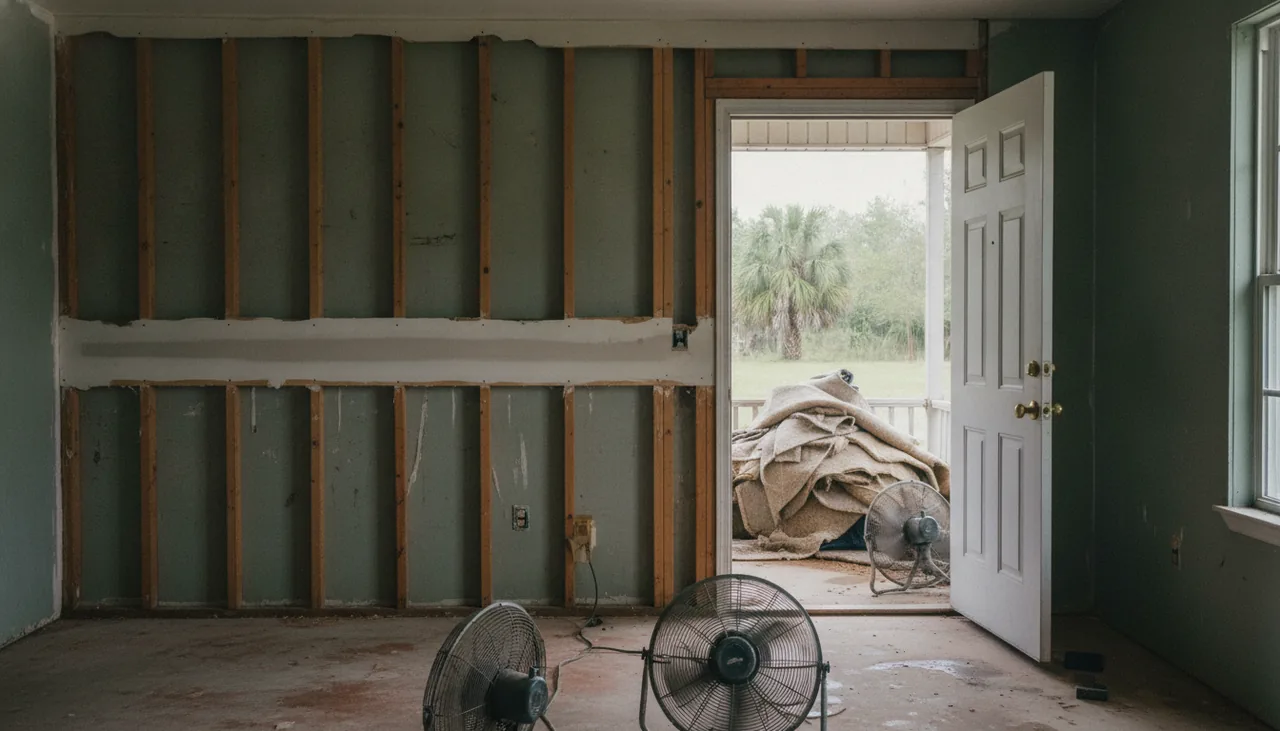
The first two days after a flood
The Louisiana Department of Health puts it plainly: if you are not able to dry your home, furniture and other items included, within 24 to 48 hours, you should assume you have mold growth. That window sets the order of the first days.
- Keep the power off to any circuit that took water until an electrician has checked it.
- Photograph every room, the water line on the walls and anything damaged, before cleanup starts.
- Open a flood insurance claim and write down the claim number.
- Get standing water out and drying started; carpet, pad and soaked furniture usually go to the curb.
- Call (337) 294-0039 for the assessment and the drying.
How post-flood mold remediation is done
The independent assessor maps the moisture in every wall and floor the water reached, which is often higher than the visible line because wallboard wicks water upward, and writes the scope. The separate remediation contractor then:
- cuts the wallboard in a straight line above the highest wet reading and removes it with the wet insulation behind it;
- takes out flooring, pad and trim that floodwater soaked;
- HEPA-vacuums, cleans and treats the studs, plates and subfloor;
- runs air movers and dehumidifiers until the framing reads dry, logging the readings;
- hands over to someone other than itself for the check before rebuilding starts.
That split is required by La. R.S. 37:2158(A)(23).
Lafayette floods and post-flood mold
August 2016. The airport recorded 10.39 inches on August 12 and 10.40 inches on August 13, and the month totaled 24.74 inches (NOAA). One part of Youngsville took 11.5 inches in three hours. The Vermilion at Surrey Street climbed from 5 feet before the storm to its crest on August 15, second only to the 24.87-foot flood of record in August 1940 and above the 16-foot major flood stage. FEMA's disaster declaration, DR-4277, covered Lafayette Parish, and the flood insurance program lists 2,480 parish claims from that month.
The coulees. The Vermilion is fed by Coulee Mine, Coulee des Poches, the Isaac Verot Coulee, Bayou Carencro, Bayou Queue de Tortue and others. At major flood stage, the National Weather Service gauge notes describe large areas flooded by water backing up those coulees.
May 2021. Another federal disaster declaration followed (DR-4606). The Surrey Street gauge crested on May 23, and the flood insurance program lists 158 parish claims from those storms.
Post-flood mold in houses that were closed up too soon
After a large flood, crews and materials can run short, and some houses get new wallboard over framing that was never fully dry. Years later the signs are a musty smell along outside walls, paint that bubbles low on the wall, or flooring that lifts. An assessment of a house that took water in August 2016 can include a check of the wall cavities and floor framing that flood reached, which adds $100 to $200 to the visit.
Flood insurance and post-flood mold remediation
Water that rises from outside is a flood-insurance matter, usually through FEMA's National Flood Insurance Program, not the homeowners policy. Lafayette Parish's current flood maps took effect on December 21, 2018. Policies in the City of Lafayette, Scott and Carencro carry a 15% discount under FEMA's Community Rating System (Class 7), and Youngsville joined on April 1, 2026 at Class 8, a 10% discount.
In Lafayette Consolidated Government's floodplain, work counts as a substantial improvement when improvements over a rolling ten-year period exceed 50% of the building's market value, and a substantially improved home must have its lowest floor at least 1 foot above base flood elevation. A large post-flood rebuild should be checked against that rule before it starts.
Keep every photo, receipt and drying record. An adjuster looking at mold after a flood will want to see what was done, and when, to dry the house.
Post-flood mold remediation cost in Lafayette
Water extraction and drying that starts within the first couple of days usually comes to around $2,000. Once growth has started, remediation runs $1,500 to $4,500 for one room, $3,000 to $12,000 for a crawl space, and $10,000 to $30,000+ for a house that took floodwater and was closed up wet, because more of it has to be opened. A clearance check is $200 to $400. Contaminated water always costs more than clean water, because more material has to go.
Post-flood mold questions
Can a flooded house be saved?
Most can. The framing is cleaned, treated and dried, and the wallboard, insulation and flooring the water reached are replaced. Call (337) 294-0039 so the assessment can show how far the water went.
How high should drywall be cut after a flood?
Above the highest wet reading, which is often higher than the water line because board wicks water upward. A moisture meter decides, not a fixed height. Call (337) 294-0039 before anyone starts cutting.
Does flood insurance pay for mold after a flood?
Policies differ, and insurers look at whether reasonable drying was done after the water went down, so keep every record. Call (337) 294-0039 for an assessment report to give your adjuster.
The house flooded a week ago and smells musty. Can the drywall stay?
After a week, wallboard and insulation that floodwater reached usually have to come out, and the framing behind them needs treating. Call (337) 294-0039 so the rooms can be measured first.
Our house took water in 2016 and was repaired then. Could mold still be in the walls?
It can, if the framing was closed up before it dried. Paint bubbling low on outside walls or a musty smell are the usual signs. Call (337) 294-0039 to ask about a flood-history check.
Who checks the house before it is rebuilt?
A person from outside the remediation contractor's firm, so the result is judged independently. Call (337) 294-0039 to have that check written into the scope.
Request a Callback
Would you rather write than phone, or is the line closed for the day? Put your details below and a call back will follow.
Prefer the phone? Call (337) 294-0039 at any hour.
Flood, storm or burst pipe?
Stop the water, take photos, and call (337) 294-0039. Extraction and drying if it is early, remediation if it is not.
Call (337) 294-0039